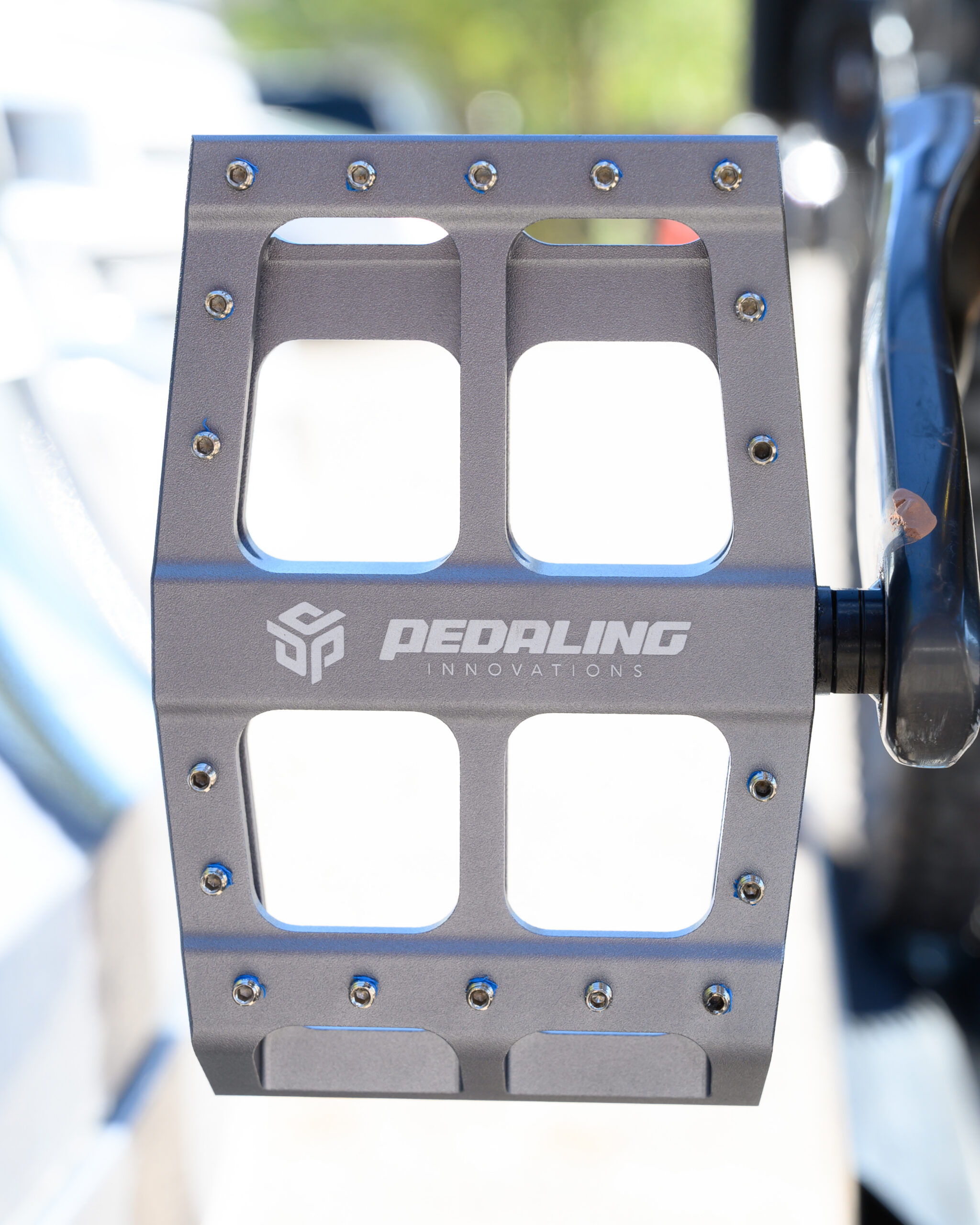
A Paradigm Shift in Flat Pedals – Our thoughts on the Pedaling Innovations Catalyst Pedal
When it comes to mountain biking and cycling in general, conventional wisdom has said that the ball of your foot should sit directly over the pedal spindle. Enter the Pedaling Innovations Catalyst Pedal, designed by fitness coach and avid mountain biker James Wilson. The Catalyst aims to completely disrupt traditional pedal design with a massive platform and a biomechanically driven philosophy: the mid-foot pedaling position.
We’ve been putting these pedals to the test for the last 6 months, and here is what we have discovered.
The Science and Theory Behind the Catalyst
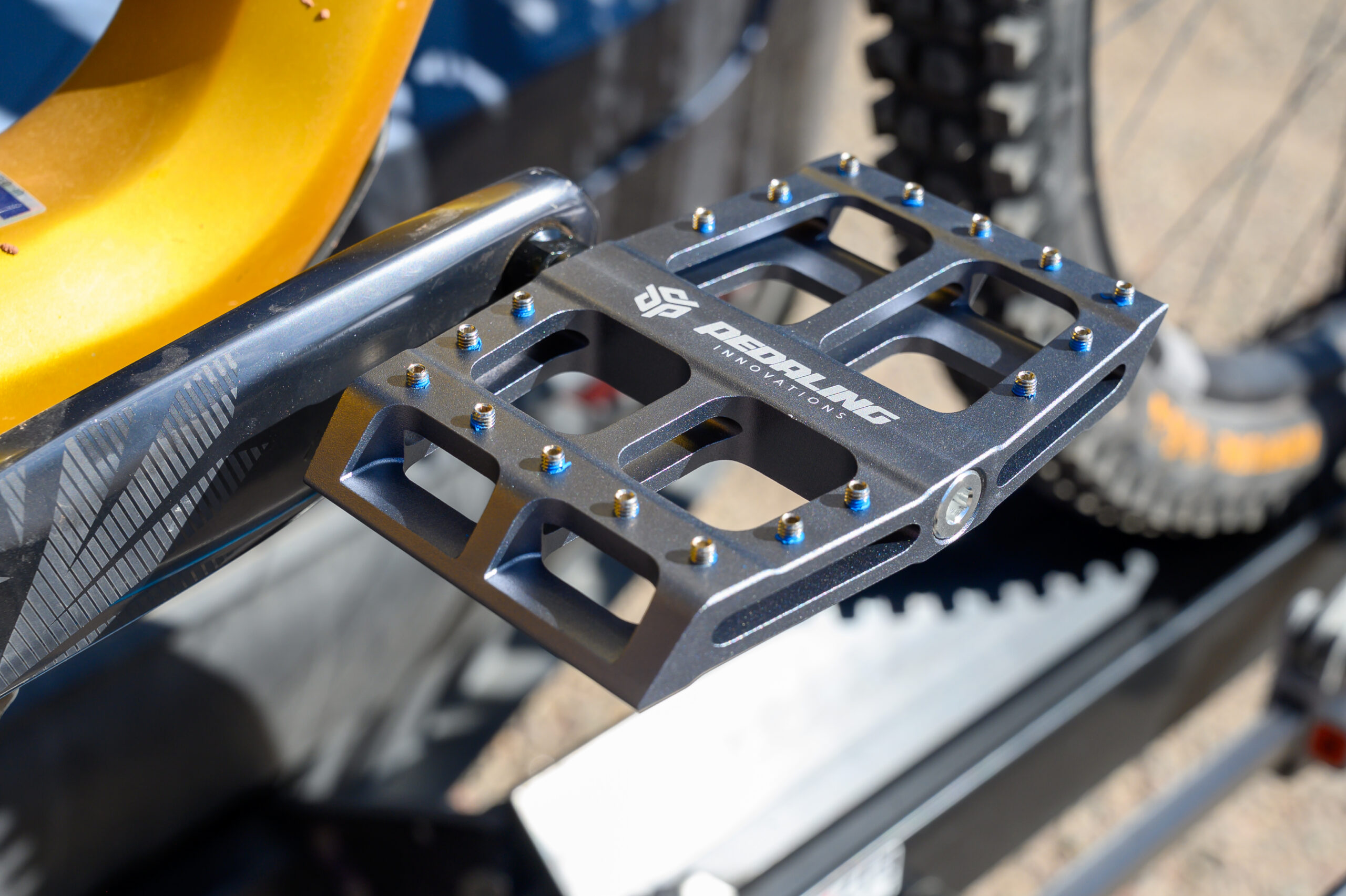
Most flat pedals on the market measure around 100mm to 110mm in length. The Catalyst comes in at a whopping 128mm to 143mm long (depending on the exact iteration and measurement points), making it the longest flat pedal on the market.
The logic behind this massive 6061 aluminum platform is simple but revolutionary. By supporting both the front and back ends of the foot’s arch, the pedal allows you to center your foot squarely over the axle. James Wilson likens this to lifting weights in the gym: you wouldn’t do a heavy squat or deadlift balancing on your tiptoes. By flattening the foot and driving through the mid-foot, the Catalyst aims to shift the workload away from the smaller, easily fatigued muscles of the calves and ankles, relying instead on the larger, more powerful muscles of the hips, glutes, and upper legs.
If you want to know what it actually feels like to ride the Catalysts, it is pretty phenomenal. I’ll admit, the very first time I stepped onto these massive platforms, it felt strange. Placing my foot that far forward on the pedal went against years of muscle memory. But that skepticism vanished the minute I hit my first steep, chunky climb.
The difference is clear. The larger platform of the pedals certainly limits calf strain. Instead of your ankles wasting energy, your foot feels like it’s planted on a solid concrete floor. You realize you are driving power straight from your hips and glutes directly into the drivetrain. I have struggled with left calf tightness on long rides for years. Using the Catalyst pedals has made a noticeable improvement in tightness and overall comfort on big days in the saddle.
On the descents, the experience is even better. Hitting a chaotic rock garden or a harsh drop that would usually bounce my feet around, I suddenly felt stable and locked-in. Because my arch was fully supported, I felt like I was riding in the bike rather than perched on it. Keeping good form and really dropping your heels on the descent is rewarding on these pedals. It’s makes a noticeable difference for leg fatigue. Finishing a brutal, four-hour trail epic without aching arches, sore knees, or cramped calves made the Catalyst pedals earn a permanent spot on my bike. Once you feel that locked-in power, it is hard to want to go back to normal flats.
Key Specifications
-
Weight: ~505 grams per pair (Standard Aluminum)
-
Dimensions: ~143mm (Length) x 95mm (Width) x 16mm (Thickness)
-
Internals: Dual sealed bearings and DU bushings on a heat-treated Cro-Mo spindle
-
Pins: Top-loading, customizable lengths (ships with short pins installed, long pins in the box)
- Cost: $159 for the Catalyst, $199 for Catalyst XL, and $249 for Catalyst Evo
The Positives
After extensive testing across various mountain biking disciplines, from cross-country and trail to downhill and bikepacking, reviewers and riders have noted several standout benefits:
- Legitimate Power and Efficiency Gains: On sustained, grueling climbs, the feeling of higher power input is noticeable. Because the mid-foot position stabilizes the ankle, less energy is wasted flexing the foot, translating more watts directly into the drivetrain.
- Increased Stability and Balance: A larger platform means a larger base of support. This reduces foot-roll and makes riders feel heavily planted and centered on the bike during rough, technical descents and big compressions. If you have a shoes size of 13 or larger, the Catalyst XL will provide support that you’ve never experienced before.
- Reduced Joint Pain: We noticed a reduction in knee, achilles, and particularly calf fatigue. By preventing the ankle from dropping violently over drops and jumps, the Catalyst acts almost like orthopedic support for your lower body.
- Shoe Versatility: Because the pedal provides full arch support, you don’t necessarily need the stiffest, most expensive riding shoes. Bikepackers and commuters love them because they are comfortable to ride with skate shoes, sneakers, or even sandals.
- Durability and Guarantee: The bearings and bushings hold up well to thousands of miles of abuse, and Pedaling Innovations offers a rare 30-day, no-questions-asked money-back guarantee, allowing skeptical riders to try them risk-free.
- Made in the USA: The standard Catalyst pedal is manufactured overseas, however the Catalyst Evo is manufactured in Grand Junction, Colorado. Seeing companies offer USA-made quality and keeping jobs stateside is a story that resonates with us at QuikrStuff. If supporting local businesses is important to you too, consider upgrading to the Catalyst Evo.
The Negatives
Despite the biomechanical advantages, these pedals are not for everyone, and they do come with a few drawbacks:
- The Weight Penalty: At over 500 grams, the Catalyst pedals are heavy. Weight-conscious riders might balk at the additional weight. For what it’s worth, other large flat pedals are about 80-100 grams lighter.
- Traction Nuances: The Catalyst has pins at the leading and trailing edges, but the center of the massive platform is blank. If you wear shoes with a pronounced heel lug, or if you accidentally revert to riding on the balls of your feet, the center can feel slippery—especially in wet and muddy conditions. Using the longer pins (included) can mostly mitigate this.
- Cascading Fit Changes: Moving your foot forward on the pedal pushes your hips back. If your bike already has a slack seat tube angle, riding the Catalysts can make you feel like your weight is positioned too far over the rear tire during steep climbs, requiring you to adjust your saddle or riding posture. If you have an older bike with a slack seat tube, this might not be the perfect pedal for you.
The Verdict
You should buy the Pedaling Innovations Catalyst Pedals if you fall into one of the following categories:
- You Suffer from Foot or Knee Fatigue: If long descents leave your calves burning and your ankles aching, the arch-supporting platform of the Catalyst will likely be a game-changer for your physical comfort.
- You Have Large Feet: Riders with US Size 11+ feet often find standard flats too small, leading to toe overhang and hot spots. The massive footprint of the Catalyst solves this instantly.
- You are a Bikepacker or Commuter: If you prefer riding in flexible, everyday shoes rather than ultra-stiff, specialized mountain bike kicks, the pedal itself provides the rigidity your shoe lacks.
- You Want to Improve Form: If you are transitioning from clipless pedals to flats and want to enforce a stable, powerful riding stance without your feet curling over the pedal edges, these are excellent training tools.
- You Toodle around Town: If your bike is your main mode of transportation, or you ride in a variety of places, the large flat pedals make it really easy to hop on and get going with whatever shoes you’re currently wearing. These are just great everyday pedals for any type of rider on any type of bike.
Ultimately, the Catalyst pedal forces you to rethink how you interact with your bike. While they may not be the lightest option on the market, the performance benefits of a mid-foot pedaling position are undeniable for riders willing to adapt to the change. From cleaning technical climbs, feeling superbly stable on gnarly descents, and providing all day comfort on bikepacking missions, these pedals have earned a permanent spot on several of our bikes!